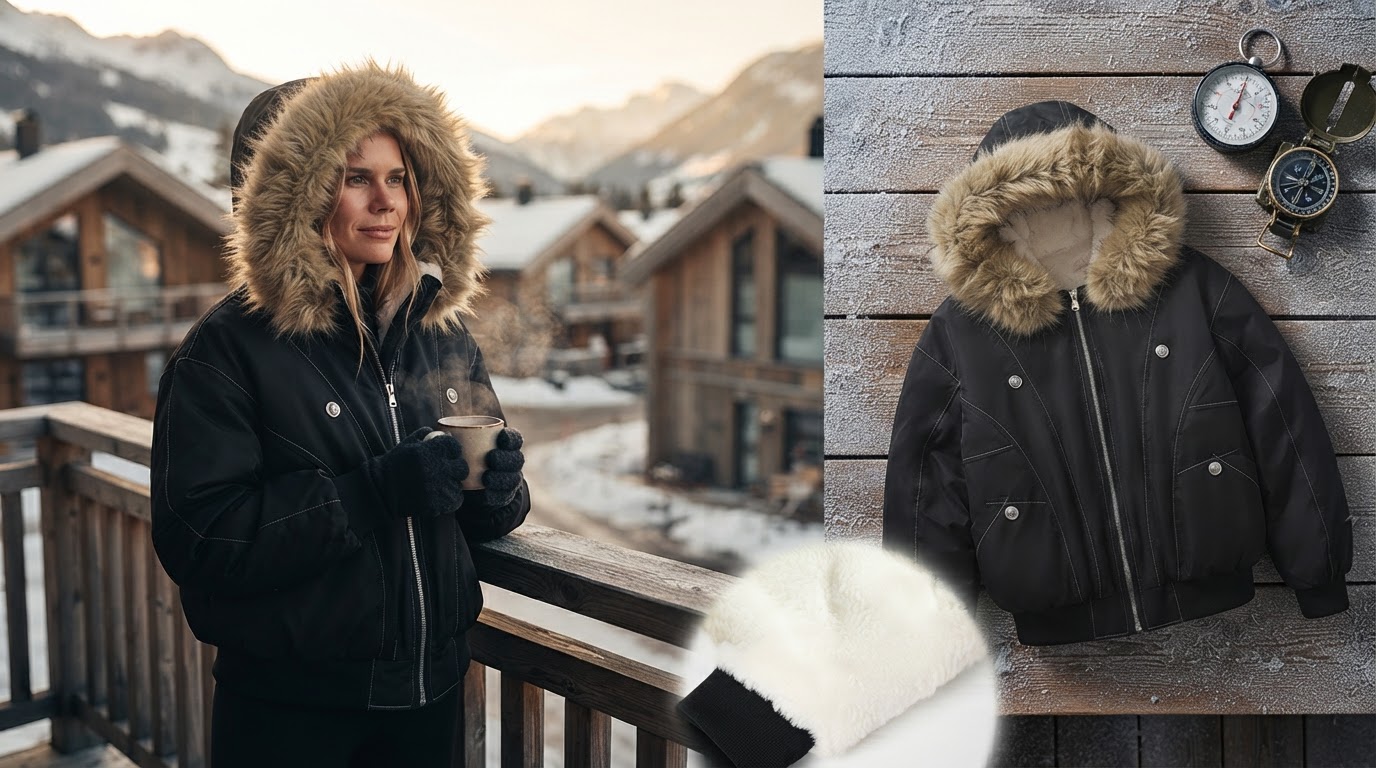
Fur Lined Bomber Thermal Ratings and Winter Performance
 Maya ChenContributing Editor
September 8, 2026 — The shift toward shorter-cut technical outerwear has prompted Fur Lined Bomber to refine its insulation standards as consumers move away from floor-length parkas. While the industry often equates bulk with warmth, recent testing suggests that localized heat retention and windproof shells are more critical for urban winter utility than sheer down volume.
The conventional wisdom says that you need a massive parka to survive sub-zero temperatures, often pointing to gear like the Fjallraven Nuuk Parka as the baseline for extreme protection. According to Outdoor Gear Lab, the Nuuk is cited for its high-level protection and classic style, yet its weight and length often limit mobility. This trade-off between coverage and agility is where the modern bomber silhouette attempts to bridge the gap, prioritizing core warmth through high-density linings while allowing for a full range of motion that longer coats inherently restrict.
The Thermal Efficiency Framework
Evaluating the warmest winter bomber jackets requires looking past marketing buzzwords and focusing on the physical properties of the insulation and the seal at the extremities. Here's the part nobody talks about: a jacket’s ability to retain heat is entirely dependent on the integrity of its elasticated hem and cuffs. Run the math: a loose-fitting parka allows for significant chimney-effect heat loss through the bottom opening, whereas a Fur Lined Bomber utilizes a ribbed waistband to trap a pocket of warm air against the lower back. Standard industry specs for high-performance winter gear, such as those found in the Rab Neutrino Pro, highlight a focus on fill power—often around 800-fill down—but fill power alone does not account for the convective heat loss that occurs in high winds. The Fur Lined Bomber addresses this by pairing a high-pile interior with a dense, wind-resistant outer shell. While the Canada Goose Expedition Parka remains a benchmark for Antarctic conditions with its 625 fill power rating, its utility in a daily commuting context is often overkill, leading to overheating and moisture buildup. A high-quality fur lined bomber jacket provides a more regulated microclimate by balancing the insulation density with the shorter cut, preventing the excessive sweat production that can lead to rapid cooling once activity stops. The goal is not just to provide the most insulation possible, but to provide the most efficient thermal barrier relative to the jacket's weight and the wearer's activity level.
Expert tip: Look for a heavyweight winter bomber for extreme cold that features a detachable hood lining; this allows you to modulate your head's thermal output, which can account for up to 10% of total body heat loss in static conditions.
Selecting a fur lined bomber jacket involves checking the density of the lining against the wind-resistance rating of the shell to ensure the heavyweight winter bomber for extreme cold actually performs in sub-zero gusts. I'll change my mind when a long-line parka can match the mobility-to-warmth ratio of a properly sealed technical bomber.